Gaudí's Crypt
Visit one of Gaudí's first works, where he applied all the architectural experiments he created in future works
Gaudi Crypt in Colonia Guell
Contents
- Table of Contents
- The history: a commission that became a turning point
- The hanging chain model — Gaudí's secret weapon
- What you'll see inside the crypt
- The roof terrace: where the church should have begun
- The colony itself: worth an hour of your time
- Practical info: hours, prices, tickets
- How to get there from Barcelona
- Is it worth the trip?

Most people do their Gaudí tour without leaving Barcelona — Sagrada Família, Park Güell, Casa Batlló, done. But the one place that explains all of it, the building where Gaudí figured out how to do everything he later became famous for, sits 30 minutes south of the city in a small town most tourists have never heard of.
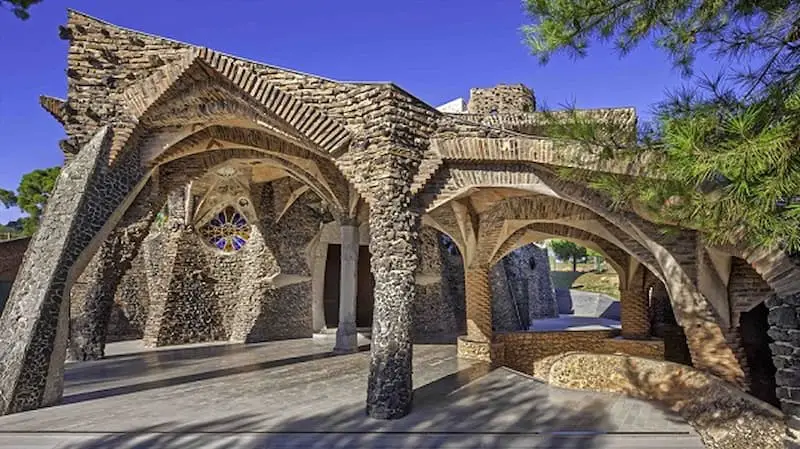
The Gaudí Crypt at Colònia Güell is an unfinished church that never became a church. What got built — just the crypt, the lower nave — was consecrated in 1915, declared a UNESCO World Heritage Site in 2005, and still stands today as one of the most structurally inventive buildings in Europe. It's also almost always quiet. If you've ever wished you could see a Gaudí building without a crowd, this is it.
Table of Contents
- The history: an experiment that changed architecture
- The hanging chain model — Gaudí's secret weapon
- What you'll see inside
- The roof terrace
- The colony itself: worth an hour of your time
- Practical info: hours, prices, tickets
- How to get there from Barcelona
The history: a commission that became a turning point

In 1898, Eusebi Güell — the same industrialist who commissioned Park Güell and Palau Güell — gave Gaudí an unusual brief: build a church for the workers of his textile colony at Santa Coloma de Cervelló, about 20 km southwest of Barcelona.
The offer came with remarkable conditions: total creative freedom and an unlimited budget. For an architect who had spent years fighting clients who reined him in, this was extraordinary. Gaudí responded with his most radical proposal yet — a five-nave structure with a central dome rising 40 metres, designed using structural principles no one had tried before.
Construction began in 1908. It continued for six years. Then, in 1914, Güell's heirs decided the project was too expensive and too large for such a small industrial town. Funding was cut. Gaudí walked away. What remained was only the crypt — the lower floor that would have supported the main church above.
It was consecrated on 3 November 1915 by the Bishop of Barcelona. The roof over the crypt — completing the structure that exists today — was added shortly after by another architect. The main church was never built. It never will be.
The hanging chain model — Gaudí's secret weapon
Here's the part most guides skip. Before construction started, Gaudí spent ten years studying the structural physics of this building — not with software, obviously, but with a method he invented himself.
He built an upside-down model of the entire church using chains, wire, and small bags of birdshot to represent weight loads. When a chain hangs freely under gravity, it takes the shape of a catenary curve — the most efficient form for carrying tension. Flip that curve upside down, and you get the most efficient form for carrying compression. In other words: the perfect arch.
Gaudí photographed this hanging model, then inverted the photograph. What he saw was a building that held itself up without buttresses — something Gothic cathedrals, despite their beauty, had never managed. Every inclined column, every parabolic arch in the crypt comes directly from that model. And when he started work on Sagrada Família, he used the same method, scaled up enormously.
The original hanging model no longer exists, but photographs of it survive. Some are displayed at the site. They're worth looking at carefully — they show an architect working out the geometry of a building the way an engineer works out the load-bearing capacity of a bridge.
What you'll see inside the crypt
The interior is small — this is a crypt, not a cathedral — but it's dense with things to look at. Give yourself at least 45 minutes inside, more if you're interested in architecture.
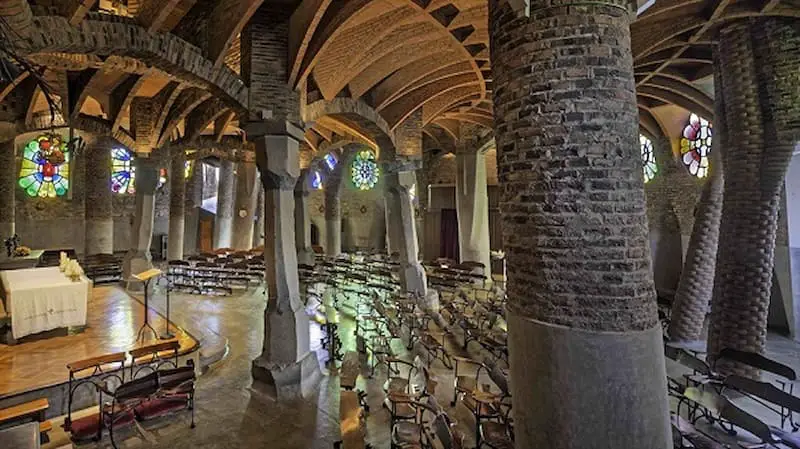
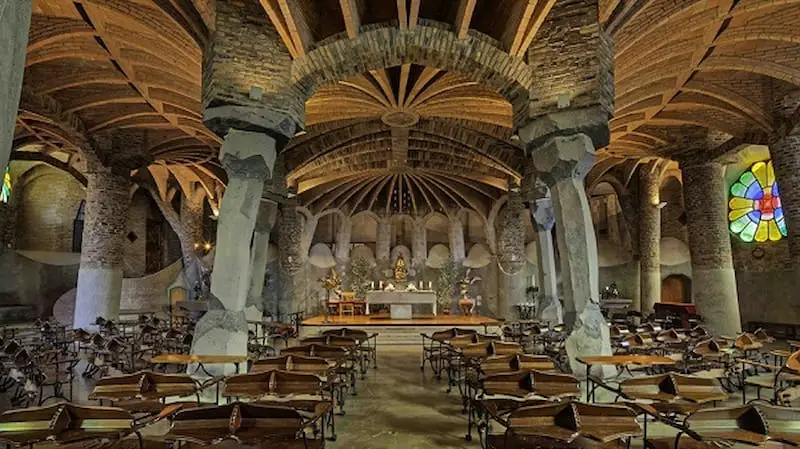
The columns. The most immediately striking feature. They're made from basalt lava stone — dark, rough, almost volcanic — and they lean inward at calculated angles rather than standing vertical. Each angle was determined by the loads they carry. The result is a forest of tilted pillars that looks organic, almost geological, but is in fact precisely engineered.
The brick vaults. The ceiling is a series of catenary vaulted arches in brick — thin, elegant, built without centring (the wooden frameworks normally used to hold arches in place while the mortar sets). Gaudí used pre-tensioned tile to build the vaults from below, a technique that later became standard in Catalan vaulting.
The stained glass. The windows are unusual — irregular shapes, non-standard colours, designed to cast specific qualities of light at specific times of day rather than to tell Bible stories in the conventional Gothic manner. Morning light hits differently from afternoon light, and Gaudí planned both.
The pews. Even the furniture is original Gaudí. The wooden pews were designed by him — shaped for the human back, not for appearances. They're still in use.

The roof terrace: where the church should have begun
After a major restoration in 2000, the crypt was opened to the public with access to the roof — the platform that would have been the main floor of the church had it ever been completed.
Standing up there, you see the outline of what Gaudí planned: the floor plan of the five naves, the positions of the columns that would have risen from the crypt below, the scale of what was abandoned. It's a strange, evocative place — an architectural ghost. Around you is the landscape of the Llobregat delta and the low hills behind Santa Coloma. Worth the climb.
The colony itself: worth an hour of your time
Colònia Güell is not just the crypt. It's a complete planned industrial village built by Eusebi Güell in the 1890s for his textile workers — housing, church, school, theatre, cooperative shop, all in one place. It was unusually progressive for its time: workers had access to education, healthcare, and leisure facilities that most Catalan industrial workers didn't.
The architecture of the colony is Modernista throughout. Several buildings were designed by Francesc Berenguer — Gaudí's chief collaborator — and the whole ensemble was declared a heritage site alongside the crypt. Walk the streets. The brick workers' houses, the old factory building, the casino (now a cultural centre) — it all tells a coherent story about Catalan industrial life at the turn of the 20th century.
The Interpretation Centre, located in the former factory building, has a permanent exhibition covering the history of the colony and the textile industry. It's included in the crypt ticket. Don't skip it — the section on the hanging chain model is the best explanation of Gaudí's structural method you'll find anywhere.
Practical info: hours, prices, tickets
Opening hours (verify before visiting — hours change seasonally):
- Monday–Friday: 10:00–19:00
- Saturday: 10:00–15:00
- Sunday: 10:00–15:00
Admission (verify current prices before visiting — these change):
- Adults: approximately €9–€10
- Children under 10: free
- Audio guide in English: included with the standard ticket
- Combined ticket with Interpretation Centre: included in standard admission
Booking in advance is not usually necessary — this is not Sagrada Família. Walk-ins are generally fine. But if you're visiting on a weekend in peak summer, checking the official Colònia Güell website before you go is sensible. You can also check current ticket availability here.
How long to allow: 1.5–2 hours covers the crypt, the roof, and the Interpretation Centre. Add another hour if you want to walk the village properly.
How to get there from Barcelona
The crypt is about 20 km from central Barcelona — roughly 30 minutes by train, which is by far the easiest way to get there.
Take the FGC railway from Plaça Espanya station on lines S3, S4, S8, or S33 (all stop at Colònia Güell). The journey takes around 25–30 minutes. Trains run frequently throughout the day.
At Colònia Güell station, cross the road and follow the blue footpath markers on the pavement — they lead you directly to the visitors' entrance, about a 10-minute walk. There's no shuttle and no complicated navigation. Just follow the blue arrows.
By car: take the A-2 motorway towards Martorell, exit at Sant Boi de Llobregat, and follow signs for Santa Coloma de Cervelló. Parking is available near the colony. If you're combining this with a day trip to somewhere else near Barcelona, a car gives you more flexibility.
Address: Carrer de Claudi Güell, s/n, 08690 Santa Coloma de Cervelló, Barcelona.
Is it worth the trip?
If you care about architecture: absolutely yes. The Gaudí Crypt is the building where Gaudí proved his structural ideas worked — before he trusted them to a cathedral. Without Colònia Güell, there is no Sagrada Família as we know it. That alone makes it worth the 30-minute train ride.
If you're more casually interested in Gaudí and have limited time, it's a harder sell. The building is small. The village is quiet. There are no big dramatic facades. But if you've already done the standard Barcelona Gaudí circuit and want something that goes deeper — this is it.
Check other Gaudí monuments
Don't miss a visit to the impressive Gaudí monuments located in Barcelona
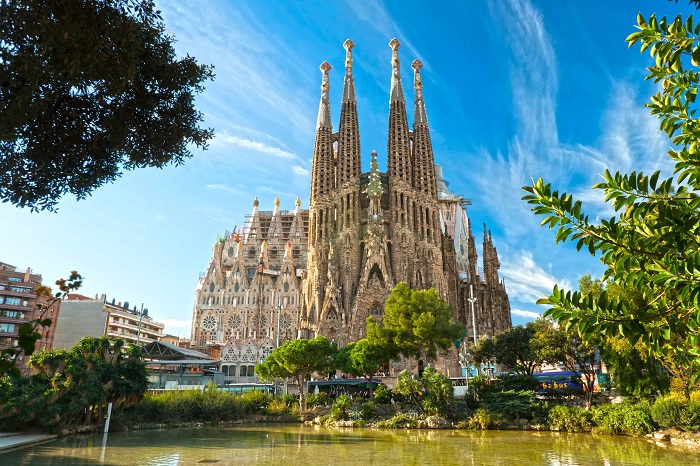
Sagrada Familia
It’s one of Gaudí’s greatest works and the symbol of Barcelona. It was the second most visited monument in Spain in 2019.
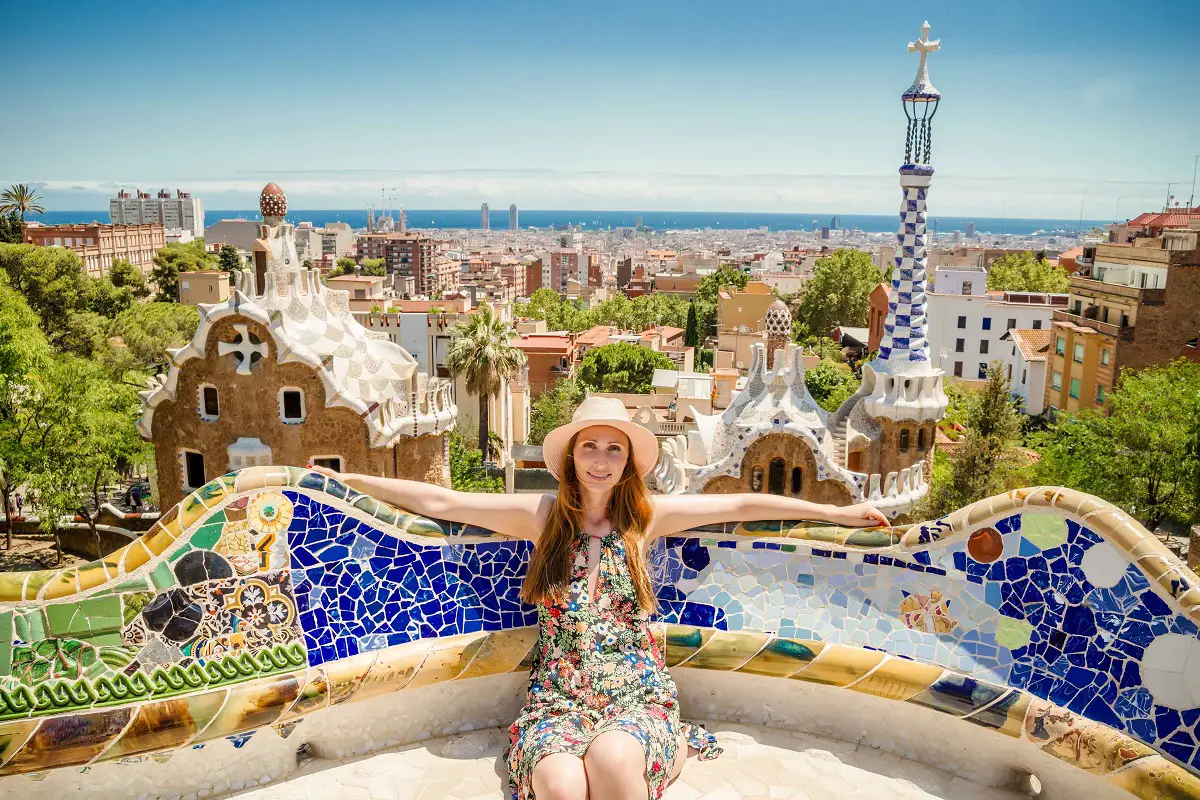
Park Güell
Out of all the projects that Antoni Gaudí built in Barcelona, Park Güell stands out as one of those special and unique places in the city.
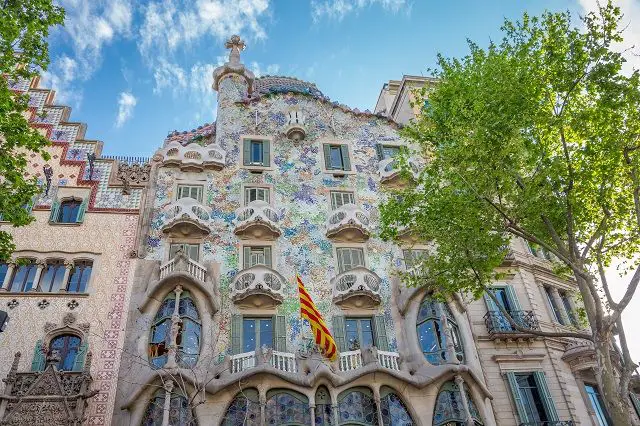
Casa Batlló
Casa Batlló is one of Barcelona’s biggest landmarks and one of the most creative designs made by Gaudi.
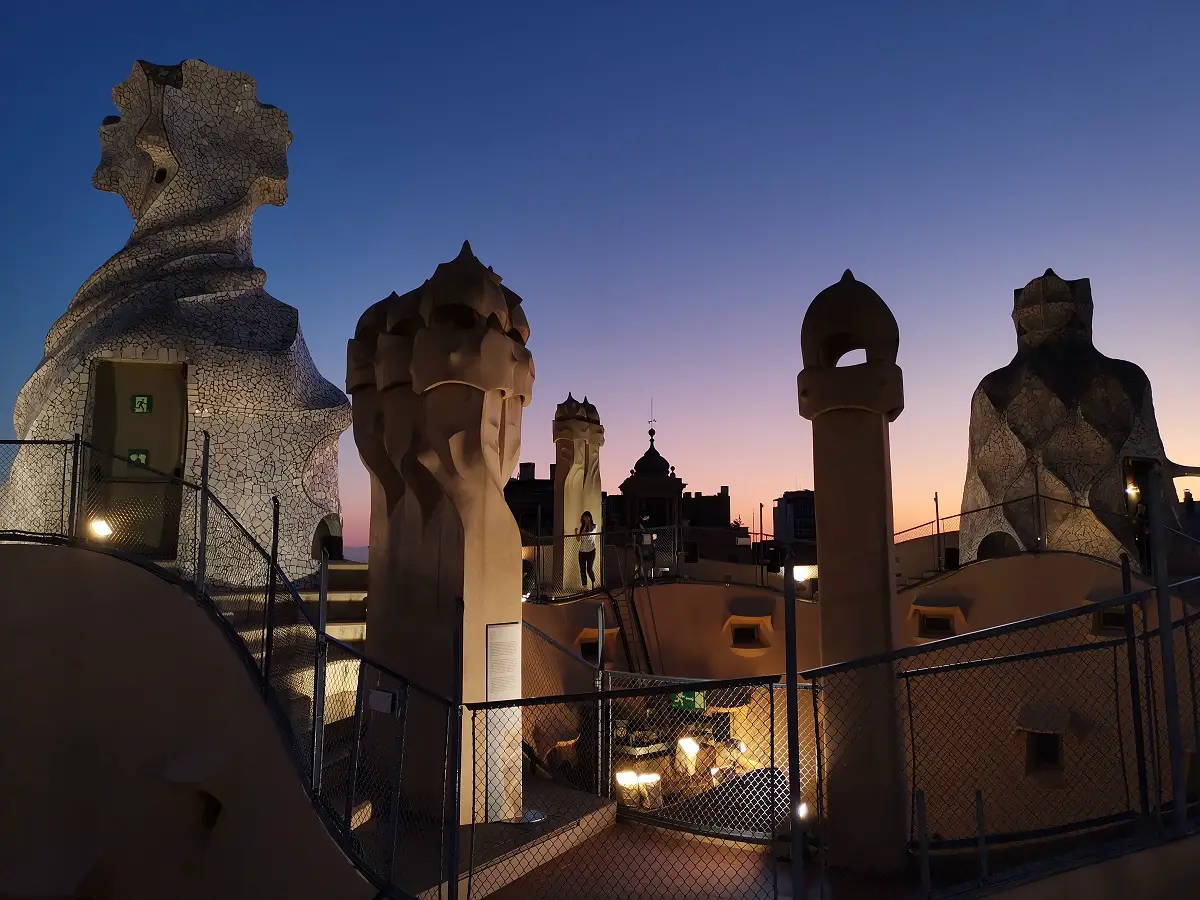
La Pedrera
La Pedrera, or Casa Milà, is one of the most famous icons of Barcelona. Designed by Gaudí, is one of the first driving forces of the modernista style.